Click to call Chris Cooper
 Click to email Chris Cooper

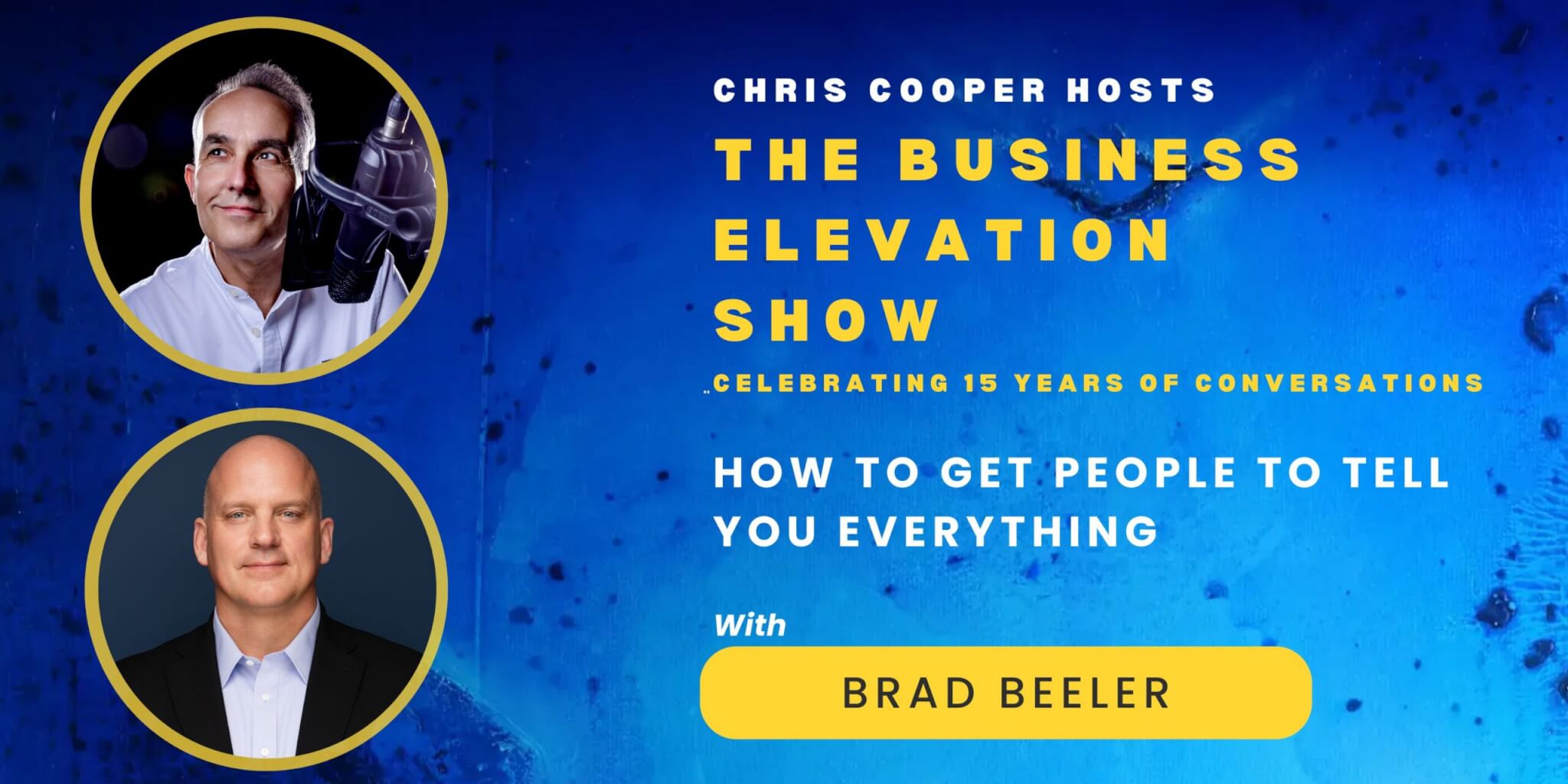
How to Get People to Tell You Everything with Brad Beeler
Every day we rely on conversations. Whether we are leading teams, raising families, negotiating deals, building relationships or making important decisions, our success often depends on our ability to build trust, understand people and uncover the truth.
In this episode of the Business Elevation Show, Chris was joined by retired United States Secret Service Special Agent Brad Beeler, author of the new book Tell Me Everything.
During a remarkable 25-year career, Brad protected U.S. presidents and foreign heads of state, conducted more criminal polygraph examinations than anyone in Secret Service history, investigated major crimes ranging from counterfeiting and homicide to terrorism and crimes against children, and now helps train interviewing and interrogation professionals within the U.S. military.
Drawing on decades of experience in some of the world’s most challenging and high-pressure situations, Brad revealed what he has learned about trust, communication, influence and human behaviour.
He explained why people often struggle to connect, how great communicators create environments where others feel safe to open up, and what leaders can learn from the techniques used by elite investigators.
Together, Chris and Brad explored the psychology of trust, the power of curiosity, the importance of first impressions, how to navigate difficult conversations, and why understanding people may be one of the most valuable skills we can develop in an increasingly complex world.
Here are some insights from the interview you don’t want to miss:
1. Building Trust Is Foundational
The truth comes after trust is established. People won’t share openly unless they like, trust, and respect you. Investing in rapport—discussing topics like family, education, employment, and leisure—creates this fertile ground for honest conversations.
2. Understand, Don’t Judge
Rather than judging people for their actions, focus on understanding their background and perspective. Withholding judgment helps create an environment where people feel safe to share sensitive information.
3. Leverage Similarities to Build Connection
Finding or referencing shared interests, backgrounds, or experiences—whether genuine or researched in advance—can build fast rapport and make others more comfortable opening up. This principle applies in positive interactions and is also exploited in scams or manipulation, underlining the importance of being thoughtful about what is shared online.
4. The Polygraph Is a Tool—Not Infallible
Polygraphs should not be used in court but can be valuable investigative tools for focusing inquiries. They measure physiological responses to questions but are highly dependent on timing, conditions, and the examiner’s skill.
5. Setup and Environment Matter
Creating a safe, private, comfortable environment (proper temperature, seating at the same level, no barriers like big desks, and removing distractions like phones) signals that it’s safe to be honest. The way a conversation starts—by saying things like “There’s nothing you can tell me I haven’t heard before”—can also open people up.
6. Physical and Vocal Cues Influence Receptivity
First impressions are crucial. Subtle behaviours—a genuine smile, a dry and warm handshake, open body language, eye contact, and using someone’s name—affect how others perceive and trust you.
Lowering your voice and slowing your pace during sensitive parts of conversations signals confidentiality and helps people feel safe to share.
7. Manage Cognitive Bias and Gut Reactions
It’s easy to be misled by first impressions and confirmation bias. Avoid labelling people as “good” or “bad” based on initial perceptions or stereotypes. Multiple, consistent interactions are more reliable in revealing character.
8. Let Others Talk (Especially Those with Ego)
Talking less and letting the other person speak 80% of the time not only reveals more information but also satisfies their need for self-expression, especially with narcissistic or egotistical individuals.
9. Monitor Nonverbal and Verbal Clues Actively
Pay attention to the words people choose, their timing in answering yes/no questions, and nonverbal reactions after you speak. Delays or overly specific qualifiers can be indicators to probe further.
10. Take Care of Yourself (Emotional Hygiene)
Absorbing heavy or traumatic content regularly can take a toll. Decompress after tough conversations—whether by speaking to a counsellor, establishing rituals to separate work from home, or engaging in physical activity. Men especially need to be encouraged to seek support when needed.
11. The Core Message: Leave People Better Than You Found Them
Strive to approach every interaction with curiosity and empathy, aiming to view things from the other person’s perspective. By doing so, you’ll build trust, encourage openness, and foster better personal and professional relationships
You should leave people better than they were when you start that interaction. And if you go in with that perspective and not a perception, you’ll be amazed at how much better your conversations are.
– Brad Beeler
You can listen to this Business Elevation Show interview with Brad Beeler & Chris Cooper here. Alternatively on Apple Podcasts, Spotify, Tunein, Amazon Music, iHeart Radio (latter US only).
More about Brad Beeler:

Brad Beeler is a retired United States Secret Service Special Agent with more than 25 years of experience conducting high-stakes interviews, interrogations, and protective operations. During his career, Brad conducted the most criminal polygraph examinations in Secret Service history and worked major cases involving crimes against children, homicide investigations, counterfeiting, terrorism, and financial crimes. He was also recognised as United States Secret Service Special Agent of the Year for his work combating crimes against children.
Brad served as an instructor at the National Center for Credibility Assessment, where he trained federal law enforcement and intelligence professionals in interviewing, elicitation, deception detection, and credibility assessment techniques. In addition to investigative work, he provided protective security for U.S. presidents and foreign heads of state.
He is the author of Tell Me Everything, where he shares practical strategies for building trust, improving communication, recognizing deception, and navigating difficult conversations. Drawing from decades of real-world experience, Brad teaches audiences how to communicate more effectively under pressure, uncover truth, and create stronger human connections in both professional and personal environments.
You may also be interested in
-
Continue reading: Bee Good Gathering 2026

Bee Good Gathering 2026
What Happens When Good People Come Together? Our Bee Good Gathering 2026 At the end of…
-
Continue reading: Kathy Caprino: Finding Brave – Navigating Change Without Losing Who You Are

Kathy Caprino: Finding Brave – Navigating Change Without Losing Who You Are
An open, practical and deeply human conversation about finding brave, navigating uncertainty and becoming more fully…
-
Continue reading: Elevate Yourself, Elevate Others and Amplify Good – Reflections from My Conversation with Kathy Caprino on Finding Brave

Elevate Yourself, Elevate Others and Amplify Good – Reflections from My Conversation with Kathy Caprino on Finding Brave
Elevate Yourself, Elevate Others & Amplify Good – Chris Cooper on Finding Brave
-
Continue reading: Siân Sutherland: Radical Naivety – The Entrepreneurial Power to Change the World
Siân Sutherland: Radical Naivety – The Entrepreneurial Power to Change the World
Radical naivety, courageous leadership, entrepreneurship, and our capacity to use business as a powerful force for…
-
Continue reading: Special Encore: Iron Man, Not Terminator: Using AI to Amplify Human Potential with Bennett Borden

Special Encore: Iron Man, Not Terminator: Using AI to Amplify Human Potential with Bennett Borden
An essential conversation for leaders, entrepreneurs, educators and anyone seeking to understand the opportunities and responsibilities that come with the…
-
Continue reading: Make Your Brain Work – The Neuroscience of High Performance Without Burnout – with Amy Brann
Make Your Brain Work – The Neuroscience of High Performance Without Burnout – with Amy Brann
Make your brain work better, elevate performance and achieve more — without burning yourself or those…
-
Continue reading: The Relationships That Shape Our Lives and Success with Dr Neil Wilkie
The Relationships That Shape Our Lives and Success with Dr Neil Wilkie
Explore what makes relationships thrive — and what causes them to deteriorate.
-
Continue reading: Inner Leadership, Global Impact with Lauren L’Amour
Inner Leadership, Global Impact with Lauren L’Amour
A fascinating and practical conversation about why transforming how we lead ourselves can transform the impact…
-
Continue reading: The Second Act Advantage: Why Your Best Years May Still Be Ahead with Jay Samit
The Second Act Advantage: Why Your Best Years May Still Be Ahead with Jay Samit
Learn how to embrace change, identify new possibilities and turn everything you’ve learned into greater purpose,…
-
Continue reading: From Grief to Belonging to the World with Barry Hoffner
From Grief to Belonging to the World with Barry Hoffner
What an extraordinary journey through life and around the world can teach us about connecting more…
-
Continue reading: Cracking The Code of Human Connection with Jennifer K. Hill
Cracking The Code of Human Connection with Jennifer K. Hill
Why, in an increasingly digital world, authentic connection may be our greatest super-power…
-
Continue reading: Why Relationships Matter More Than Ever In The Age of AI with Judy Robinett
Why Relationships Matter More Than Ever In The Age of AI with Judy Robinett
Listen for a timely, practical and inspiring conversation about leadership, innovation, opportunity and why the right…









We’ve worked with