Click to call Chris Cooper
 Click to email Chris Cooper

Psychological Safety at Work with Mehmet Baha
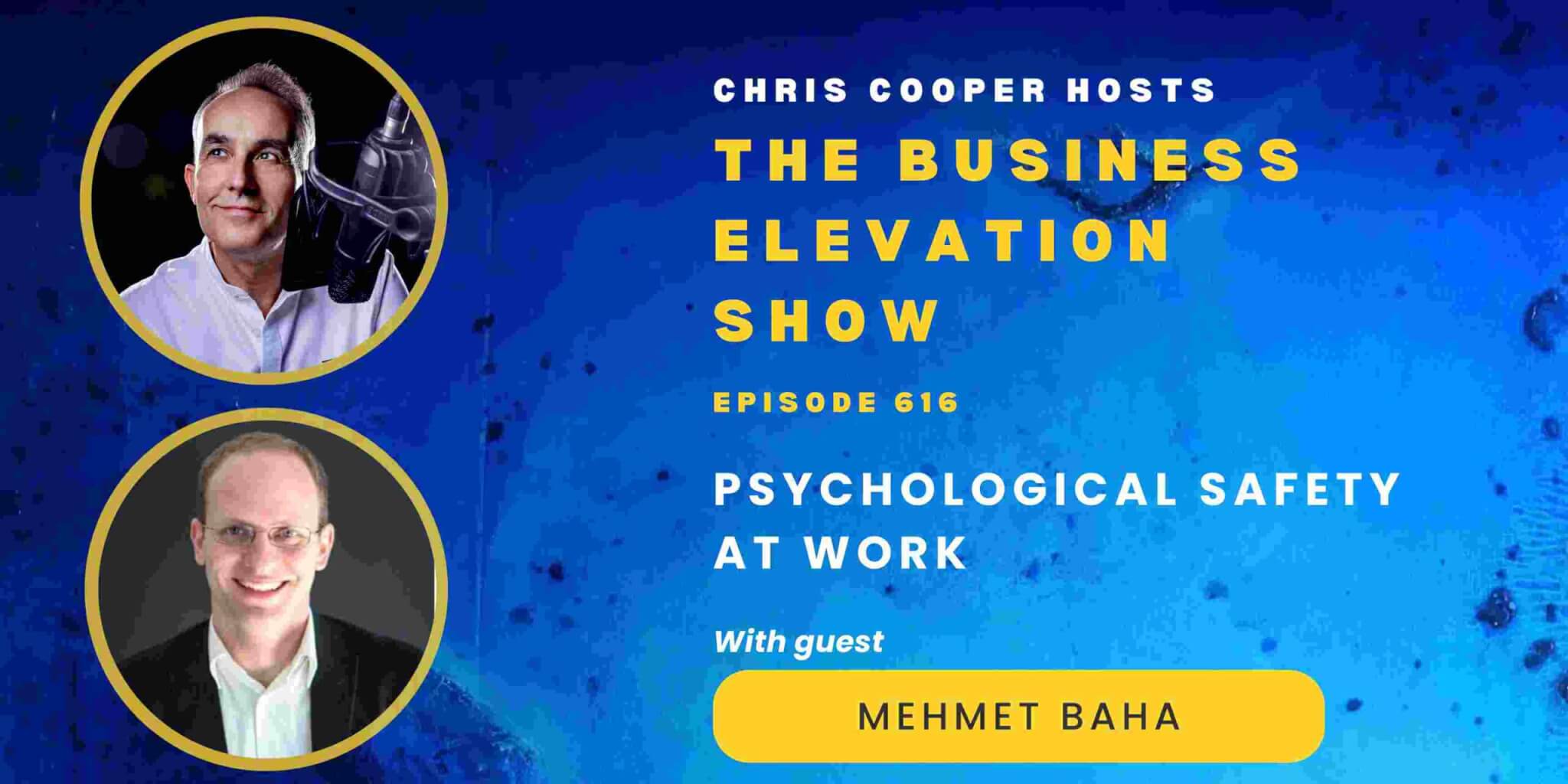
What does it really take to create a workplace where people feel safe to speak up, take risks, and perform at their very best?
In this episode, Chris Cooper is joined by Mehmet Baha, known simply as Baha, an international speaker, trainer, and author whose life’s mission has been to make a positive difference in people’s lives.
With over 24 years of global experience across Europe, the USA, Turkey, and Central America, Baha has worked with organisations of all sizes—including being one of the first employees at Facebook in Europe.
A Fulbright Scholar with a Master’s in Conflict Resolution and a graduate of Harvard Business School’s Online Executive Programme in Organisational Leadership, Baha is passionate about helping leaders unlock the power of psychological safety.
His new book, Creating Psychological Safety at Work—praised by Daniel Pink as “a timely book filled with fascinating case studies, robust research, and practical tools for driving change”—offers a roadmap for building high-performing, engaged teams.
Baha has delivered talks and training in more than 28 countries across 5 continents, speaking four languages fluently, and bringing a unique perspective shaped by his multicultural journey.
Beyond his professional work, he is a percussionist, an avid traveller, and a father who enjoys playing basketball with his young daughter.
Here are some insights from the interview you won’t want to miss:
Definition of Psychological Safety: Baha described psychological safety as a workplace environment where employees feel safe to express their questions, concerns, ideas, and mistakes without fear of negative consequences. It’s a core driver of high-performing teams.
Impact on Business Outcomes: Creating psychological safety leads to significant benefits, such as reducing employee turnover (27%), reducing safety incidents (40%), and increasing productivity (12%), according to research cited by Baha.
The Importance of Leaders: Leaders play a crucial role in fostering psychological safety. This includes modeling vulnerability, proactively asking for feedback, and appreciating team members.
Mistake Types and Responses: Not all mistakes are equal. Baha introduced the concept of distinguishing between unacceptable, improvable, complex, and intelligent mistakes—and encourages leaders to respond appropriately rather than resorting to blame.
Feedback Culture: High-performing teams have a 3–5:1 ratio of positive to negative feedback. Leaders should make appreciation a habit and seek specific, feed-forward feedback rather than vague or solely critical input.
Curiosity and Communication: To encourage openness, leaders can use a variety of question types (open, empathetic, advice, clarifying, and more) to invite input and understanding, instead of making judgments.
Vulnerability and Compassion: Sharing mistakes and lessons learned models vulnerability and reinforces trust. Compassion in leadership—demonstrated through genuine care and humane treatment, especially in tough situations like layoffs—helps build long-term respect and psychological safety.
Practical Habits to Build Safety: Baha recommended simple but powerful habits like starting meetings with personal check-ins, getting to know team members as individuals, and taking time to show humanity during both routine and difficult conversations.
Cultural Differences and Adaptability: Both Baha and Chris Cooper discussed their international experiences, highlighting that organisational cultures differ, but the universal need for psychological safety remains. Adapting communication style and humour to the cultural context is also important.
Sustaining Behavioural Change: Awareness, interest, knowledge, action, and sustainability are essential steps in embedding psychological safety into organisational culture. It takes ongoing self-reflection and deliberate practice.
Psychological Safety Beyond Work: The takeaways are relevant not just in business but in families and communities—anywhere open communication, collaboration, and learning from mistakes are valued.
When employees feel that their opinions count, we see 27% reduction in employee turnover, 40% reduction in safety incidents, and 12% increase in employee productivity – Mehmet Baha
Join us for this conversation to explore why psychological safety is not just a “nice to have,” but an essential foundation for team performance, innovation, and wellbeing—and how you can begin creating it in your own workplace
You can listen to this Business Elevation Show interview with Mehmet Baha & Chris Cooper here. Alternatively on Apple Podcasts, Spotify, Tunein, Amazon Music, iHeart Radio (latter US only).
More about Mehmet Baha:

His full name is Mehmet Baha and everyone calls him Baha.
Since his childhood, he has been fascinated by the question: “How can I make a difference in the lives of people?” His interest leads him to win a scholarship from Fulbright and finish his master’s in the USA on the topic of Conflict Resolution.
He has lived and worked in Germany, Turkey, Ireland, Guatemala, and the USA with more than 24 years of work experience.
Baha was one of the first employees of Facebook in Europe. Throughout his life, he has realized the importance of having psychological safety to create high-performing teams. So far, he has delivered training and given talks in more than 28 countries across 5 continents.
Recently, he completed Harvard Business School’s Online Executive Education Programme “Organisational Leadership”. He is fluent in English, Spanish, Turkish, and German. In his free time, he loves to play percussion, travel with his family, and play basketball with his 8-year-old daughter.
“Playbook for Engaged Employees“ is his first book. In September 2024, his second book “Creating Psychological Safety at Work“ was published. Daniel Pink, #1 New York Times bestselling author, describes it as a “timely book filled with fascinating case studies, robust research, and practical tools for driving change.”
You may also be interested in
-
Continue reading: Marc Chandler: The Age of Surplus – When More Is No Longer the Answer

Marc Chandler: The Age of Surplus – When More Is No Longer the Answer
Explore how our pursuit of ever more growth and consumption shapes business, inequality, political power and…
-
Continue reading: Bee Good Gathering 2026

Bee Good Gathering 2026
What Happens When Good People Come Together? Our Bee Good Gathering 2026 At the end of…
-
Continue reading: Kathy Caprino: Finding Brave – Navigating Change Without Losing Who You Are
Kathy Caprino: Finding Brave – Navigating Change Without Losing Who You Are
An open, practical and deeply human conversation about finding brave, navigating uncertainty and becoming more fully…
-
Continue reading: Elevate Yourself, Elevate Others and Amplify Good – Reflections from My Conversation with Kathy Caprino on Finding Brave

Elevate Yourself, Elevate Others and Amplify Good – Reflections from My Conversation with Kathy Caprino on Finding Brave
Elevate Yourself, Elevate Others & Amplify Good – Chris Cooper on Finding Brave
-
Continue reading: Siân Sutherland: Radical Naivety – The Entrepreneurial Power to Change the World
Siân Sutherland: Radical Naivety – The Entrepreneurial Power to Change the World
Radical naivety, courageous leadership, entrepreneurship, and our capacity to use business as a powerful force for…
-
Continue reading: Special Encore: Iron Man, Not Terminator: Using AI to Amplify Human Potential with Bennett Borden

Special Encore: Iron Man, Not Terminator: Using AI to Amplify Human Potential with Bennett Borden
An essential conversation for leaders, entrepreneurs, educators and anyone seeking to understand the opportunities and responsibilities that come with the…
-
Continue reading: Make Your Brain Work – The Neuroscience of High Performance Without Burnout – with Amy Brann
Make Your Brain Work – The Neuroscience of High Performance Without Burnout – with Amy Brann
Make your brain work better, elevate performance and achieve more — without burning yourself or those…
-
Continue reading: The Relationships That Shape Our Lives and Success with Dr Neil Wilkie
The Relationships That Shape Our Lives and Success with Dr Neil Wilkie
Explore what makes relationships thrive — and what causes them to deteriorate.
-
Continue reading: Inner Leadership, Global Impact with Lauren L’Amour
Inner Leadership, Global Impact with Lauren L’Amour
A fascinating and practical conversation about why transforming how we lead ourselves can transform the impact…
-
Continue reading: The Second Act Advantage: Why Your Best Years May Still Be Ahead with Jay Samit
The Second Act Advantage: Why Your Best Years May Still Be Ahead with Jay Samit
Learn how to embrace change, identify new possibilities and turn everything you’ve learned into greater purpose,…
-
Continue reading: From Grief to Belonging to the World with Barry Hoffner
From Grief to Belonging to the World with Barry Hoffner
What an extraordinary journey through life and around the world can teach us about connecting more…
-
Continue reading: Cracking The Code of Human Connection with Jennifer K. Hill
Cracking The Code of Human Connection with Jennifer K. Hill
Why, in an increasingly digital world, authentic connection may be our greatest super-power…


We’ve worked with